


Press
FTD Registry Publishes First Full-length, Peer-reviewed Article in 2022

The FTD Disorders Registry in collaboration with the Association for Frontotemporal Degeneration (AFTD) published its first full-length, peer-reviewed journal article in 2022.
Read MoreQuick Question December 2022 Results: With Whom Does/Did the FTD-diagnosed Person Live?
Of the 817 responses to our Quick Question, nearly half (400) indicated that the FTD-diagnosed person lives or lived with their spouse and children …
Read MoreFTD Registry Receives 2022 MarDreamies Award for Grassroots Innovation
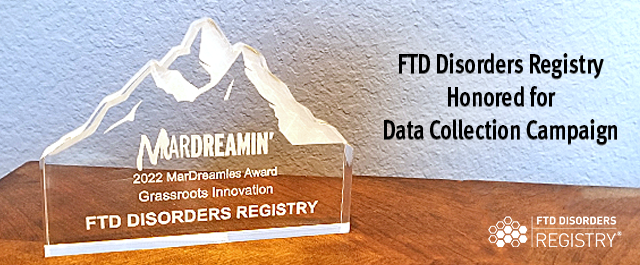
The FTD Disorders Registry received the 2022 MarDreamies Award for Grassroots Innovation for its use of technology to collect data from participants …
Read MoreCurePSP Community Conversations Webinar February 2, 2023

CurePSP is hosting a Community Conversations webinar about “The Powerful Role of Grandchildren Caring for PSP, CBD, and MSA” on Thursday, February 2
Read MoreQuick Question November 2022 Results: At what age did the FTD-diagnosed person show their first symptom?
The age range most reported for when the first frontotemporal degeneration (FTD) symptom appeared was between 55 and 59 years (158 people)
Read MoreCurePSP Ask the Expert with Dr. Travis Turner: Dec. 12, 2022

Travis Turner, PhD, will discuss Assessing Cognitive Changes with PSP, CBD, and MSA during a CurePSP Ask the Expert webinar on Monday, Dec.
Read MoreCurePSP Virtual Fall Family Conference: December 9 and 16, 2022

Learn about management techniques for PSP, CBD, and MSA during the CurePSP’s Virtual Fall Family Conference on two Fridays December 9th and 16th. Each day will feature different speakers who will present on different topics.
Read MoreQuick Question October 2022 Results: At What Age Were You (or Your Loved-One) Diagnosed with FTD?

The age range that most people received a diagnosis of frontotemporal degeneration (FTD) was between 60 and 64 years (182 people), according to…
Read MoreThe Promise of FTD Research Trials: A Webinar on December 7, 2022

Perspectives in FTD Research Webinar Series
Read MoreFeatured Study: Veri-T

A clinical trial seeking a disease-modifying therapy for people with svPPA A new clinical trial that is testing a known drug hopes to slow the progression of semantic variant primary progressive aphasia (svPPA). It will test the effects of verdiperstat on cerebrospinal fluid (CSF) proteins, brain magnetic resonance imaging (MRI), and cognitive tests. A Trial of Verdiperstat in Patients With svPPA…
Read More