


PRESS & NEWS
FTD Disorders Registry Research at CTAD 2025
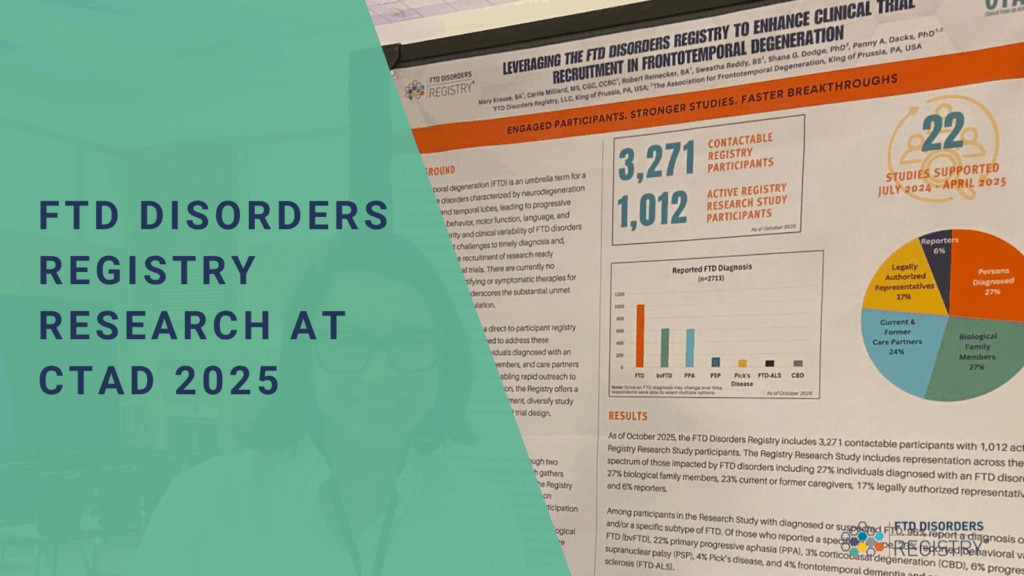
The FTD Disorders Registry was featured at CTAD in San Diego, where a poster presented by Dr. Shana Dodge highlighted how the Registry is helping accelerate clinical trial recruitment in frontotemporal degeneration.
This month, the FTD Disorders Registry was represented at the Clinical Trials on Alzheimer’s Disease (CTAD) conference in San Diego, where Shana Dodge, PhD from The Association for Frontotemporal Degeneration presented a poster authored by Mary Krause titled “Leveraging the FTD Disorders Registry to Enhance Clinical Trial Recruitment in Frontotemporal Degeneration.”
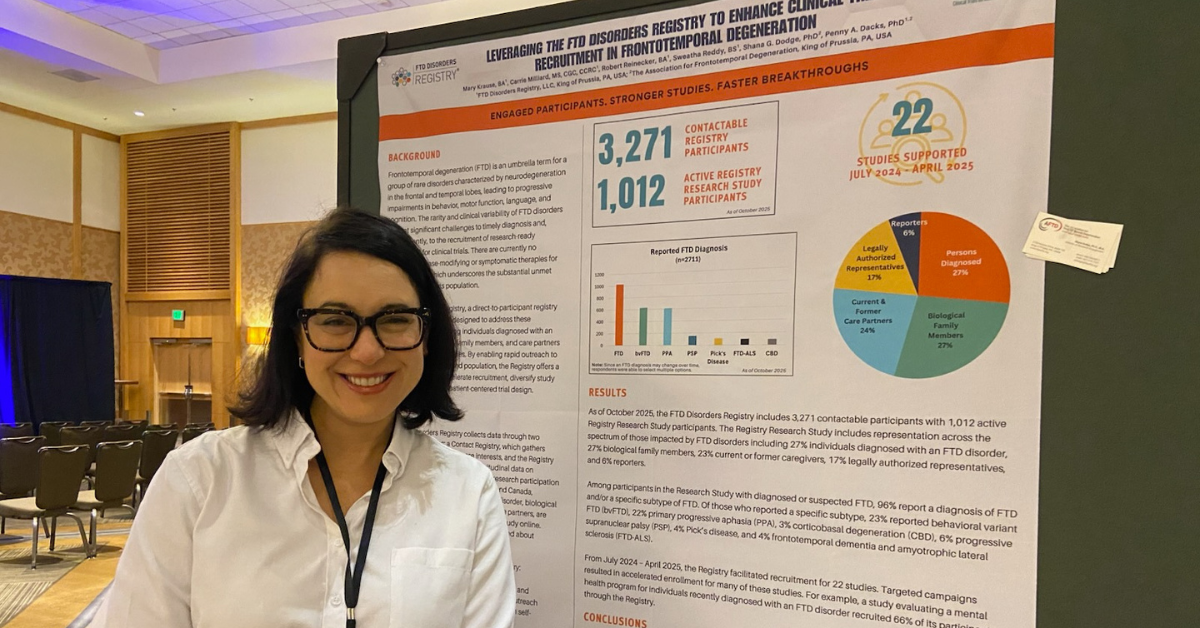
CTAD brings together international leaders in neurodegenerative disease research, making it an important venue to share practical, data-driven approaches to advancing clinical trials. The poster highlighted how the FTD Disorders Registry is helping to address one of the most persistent challenges in frontotemporal degeneration (FTD) research: identifying and enrolling research-ready participants in a rare and clinically diverse population.
As outlined in the poster, the Registry currently includes more than 3,200 contactable participants, with over 1,000 actively enrolled in the Registry Research Study. Participants represent the full spectrum of individuals impacted by FTD disorders, including people diagnosed with FTD, biological family members, current and former care partners, and legally authorized representatives. This breadth allows the Registry to support a wide range of study designs, from observational research to interventional trials.
The presentation emphasized the Registry’s direct-to-participant model and its ability to facilitate targeted, IRB-approved outreach, participant prescreening, and site matching based on self-reported characteristics and geography. Between July 2024 and April 2025 alone, the Registry supported recruitment for 22 studies, with several studies achieving accelerated enrollment through tailored Registry campaigns. One highlighted example showed that 66 percent of participants in a mental health study for individuals recently diagnosed with FTD were recruited through the Registry.
By sharing these results at CTAD, Dr. Dodge underscored the Registry’s role as scalable research infrastructure that can improve trial readiness, enhance cohort diversity, and center the voices of individuals and families living with FTD. As the therapeutic landscape for FTD continues to evolve, the Registry is well positioned to support sponsors and investigators in bringing studies to the community more efficiently and equitably.
The poster was presented at CTAD by Dr. Dodge and authored by Mary Krause, with contributions from Carrie Milliard, MS, CGC, CCRC; Robert Reinecker, BA; Sweatha Reddy, BS; and Penny A. Dacks, PhD. This work reflects the collective efforts of the FTD Disorders Registry team and the thousands of Registry participants who share their experiences to advance FTD research.
Together we can find a cure for ftd
The FTD Disorders Registry is a powerful tool in the movement to create therapies and find a cure. Together we can help change the course of the disease and put an end to FTD.

Your privacy is important! We promise to protect it. We will not share your contact information.