


PRESS & NEWS
FTD Is Not One Disease: Why Subtypes Matter for Research
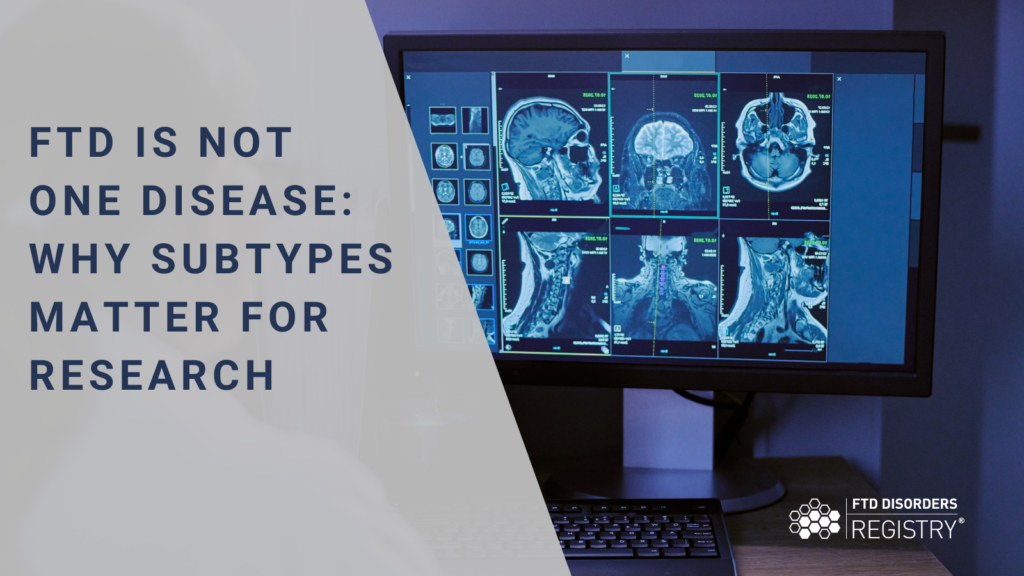
FTD is a spectrum, not a single diagnosis. Recognizing the differences between subtypes helps researchers design smarter studies, accelerate discoveries, and move us closer to effective treatments.
When people hear the term frontotemporal degeneration (FTD), it can sound like a single diagnosis.
It is not.
FTD is an umbrella term for a group of related brain disorders that affect the frontal and temporal lobes of the brain. These regions control behavior, personality, language, decision-making, and movement. While these conditions share certain features, they differ in symptoms, underlying biology, genetics, and progression.
Understanding those differences is essential. Because in research, precision matters.
The Major Clinical Subtypes of FTD
The FTD spectrum includes several primary clinical presentations:
Behavioral Variant FTD (bvFTD)
This is the most common form. It primarily affects personality and behavior. People may experience changes in judgment, empathy, impulse control, or motivation. These changes can be mistaken for psychiatric conditions early on.
Primary Progressive Aphasia (PPA)
PPA primarily affects language. It has three main variants:
- Nonfluent/agrammatic variant PPA
- Semantic variant PPA
- Logopenic variant PPA
Each affects language in a different way, from difficulty forming words and sentences to loss of word meaning or trouble retrieving words.
FTD with Motor Syndromes
Some individuals develop movement-related disorders, including:
- Progressive supranuclear palsy (PSP)
- Corticobasal syndrome (CBS)
- FTD-ALS (when frontotemporal degeneration overlaps with amyotrophic lateral sclerosis)
These conditions may include stiffness, balance problems, slowed movement, or muscle weakness.
Although these diagnoses look different clinically, they can share overlapping brain changes at the cellular level.
Why Subtypes Matter in Research
If FTD were a single disease with a single cause, research would be more straightforward. But FTD involves multiple underlying protein pathologies, including tau, TDP-43, and FUS. Different subtypes are associated with different protein changes.
That distinction matters because:
- A treatment targeting tau may not work for someone whose disease is driven by TDP-43.
- Genetic forms of FTD (such as those linked to C9orf72, GRN, or MAPT) may follow different trajectories.
- Clinical trials must enroll the right participants to test the right therapies.
Without identifying subtypes accurately, research risks mixing biologically different conditions into the same study group. That can dilute results and slow progress.
Precision is not just a scientific preference. It is a necessity.
Genetics and the Research-Ready Community
Up to 40 percent of people diagnosed with FTD have a family history, and a significant portion have identifiable genetic variants. Those living with genetic forms of FTD may be eligible for gene-targeted clinical trials.
At the same time, people without a known genetic cause are equally important to research. Understanding sporadic cases helps researchers identify new risk factors, biomarkers, and therapeutic targets.
When individuals share information about their specific diagnosis, symptoms, and genetic status, they help researchers design better studies. Subtype data strengthens the entire research ecosystem.
Why This Matters for You
Being counted is not just symbolic. It is strategic.
When researchers can see how many people are living with bvFTD versus semantic variant PPA, or how many report FTD-ALS, they gain insight into prevalence, progression patterns, and research gaps.
Data helps answer critical questions:
- Are certain subtypes underrepresented in clinical trials?
- Do diagnostic delays differ across variants?
- Are motor symptoms being captured early enough?
Every subtype represented brings us closer to targeted therapies.
One Spectrum, Many Pathways Forward
FTD is not one disease. It is a spectrum of related but distinct disorders.
Recognizing that complexity does not make the research harder. It makes it smarter.
The more precisely we understand the subtypes of FTD, the better positioned we are to develop therapies that are tailored, effective, and meaningful for the people impacted.
Because progress depends on clarity.
And clarity begins with understanding the differences.
Together we can find a cure for ftd
The FTD Disorders Registry is a powerful tool in the movement to create therapies and find a cure. Together we can help change the course of the disease and put an end to FTD.

Your privacy is important! We promise to protect it. We will not share your contact information.