


PRESS & NEWS
The Future of Collaborative Research in Frontotemporal Degeneration
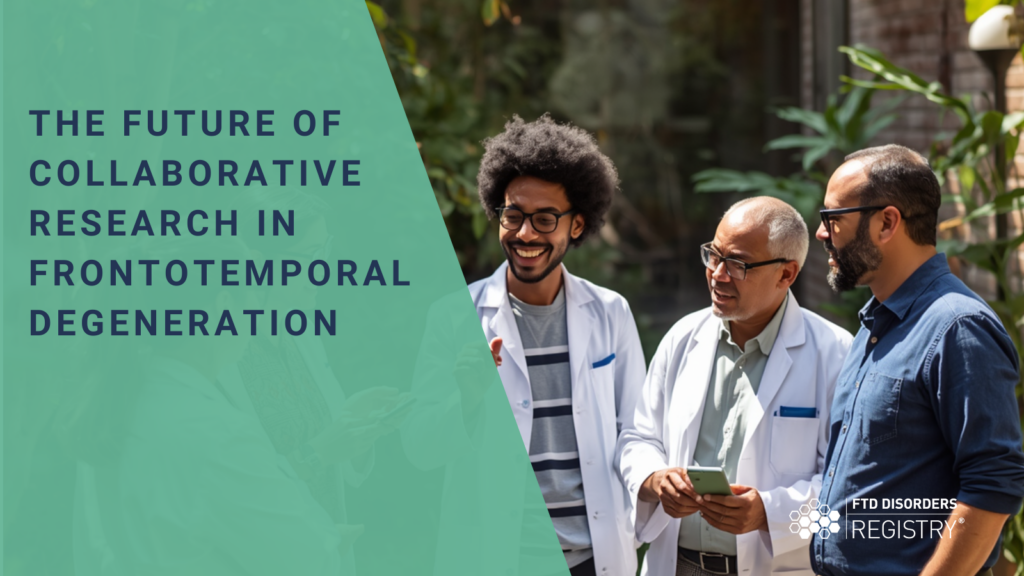
Frontotemporal degeneration research is becoming more collaborative, offering real momentum toward faster trials and more meaningful progress for families impacted by the disease.
Frontotemporal degeneration (FTD) research is entering a period of meaningful change. While progress has not always moved as quickly as needed, there is growing momentum toward more connected and collaborative approaches. New tools, stronger partnerships, and increased engagement from patients, families, clinicians, and researchers are helping to reshape how the field works. There is still work to do, but the direction is clearer, and the potential for faster, more coordinated progress has never been greater.
A disease that demands collaboration
FTD is not a single condition with a single cause or pathway. It includes a group of disorders with overlapping symptoms, genetics, and pathology. That complexity has made research and clinical trials especially challenging, particularly when it comes to comparing findings across studies or designing efficient trials.
Because of this, no single institution or organization can move the field forward on its own. Progress depends on coordinated effort across many groups, including:
- Academic centers studying disease mechanisms
- Industry partners developing potential therapies
- Advocacy organizations supporting families and awareness
- Individuals and care partners sharing lived experience
- Research platforms that help connect and organize data
Collaboration is no longer just helpful. It is necessary.
The growing role of participant-centered infrastructure
One of the most meaningful shifts in recent years has been the development of participant-centered research infrastructure, including online registries and longitudinal data platforms. These tools allow individuals affected by FTD to voluntarily share information about their health, experiences, and priorities in a way that directly supports research.
The FTD Disorders Registry is one example of this approach. It helps close the gap between research studies and the people who may be eligible to participate in them. Instead of relying only on site-based recruitment, researchers can more quickly and efficiently connect with potential participants who are already engaged and interested.
This improves both speed and reach, which is especially important in rare diseases where participants are geographically dispersed.
Connecting observational research and clinical trials
There is also growing recognition that observational research and clinical trials work best when they are closely connected.
Observational studies help describe how the disease progresses, what symptoms matter most to patients and families, and how outcomes change over time. Clinical trials then build on that knowledge to test potential treatments.
When these efforts are better aligned, the entire research process becomes more efficient:
- Observational data helps shape trial design
- Natural history studies inform endpoint selection
- Registry data supports feasibility planning
- Recruitment becomes more targeted and efficient
This kind of integration helps reduce delays and strengthens the overall quality of research.
The importance of global collaboration
Because FTD is rare, no single country or research center has enough participants or data to answer all the key questions on its own. Global collaboration is therefore essential.
Researchers across countries are increasingly working together by sharing protocols, aligning outcome measures, and coordinating recruitment strategies. This allows studies to be more efficient and results to be more broadly applicable.
Bringing lived experience into the center
One of the most important shifts in the field is the growing recognition that lived experience is not secondary to research. It is part of the evidence base.
People living with FTD and their care partners provide insight into:
- How symptoms change over time
- What daily challenges matter most
- Which outcomes are meaningful in real life
- What makes research participation easier or harder
More studies are now incorporating this perspective earlier in the process, rather than after protocols are already finalized. That leads to research that is more relevant, more grounded, and ultimately more useful.
Looking ahead
The future of collaborative research in FTD will depend on connection. Connection between datasets, between institutions, and between people.
As infrastructure continues to improve and collaboration becomes more routine, the field is moving toward a research ecosystem that is:
- Faster in launching trials
- More effective in identifying participants
- Better at integrating data across studies
- More reflective of real-world experience
Most importantly, it brings the field closer to treatments that make a meaningful difference for individuals and families impacted by FTD.
No single effort will get us there on its own. Progress will come from many groups working in parallel, and increasingly, working together.
Together we can find a cure for ftd
The FTD Disorders Registry is a powerful tool in the movement to create therapies and find a cure. Together we can help change the course of the disease and put an end to FTD.

Your privacy is important! We promise to protect it. We will not share your contact information.