


PRESS & NEWS
What the Registry Community Is Most Interested In

Registry data reveal which FTD subtypes and genes have the highest representation of research-ready participants, helping scientists design stronger, more focused studies.
When people join the FTD Disorders Registry, they can indicate which subtypes and genes they are most interested in. These selections offer more than insight into curiosity or awareness. They highlight where the largest numbers of research-ready participants are already engaged and where researchers may find the strongest foundation for future studies and trials.
Subtypes with the Highest Representation
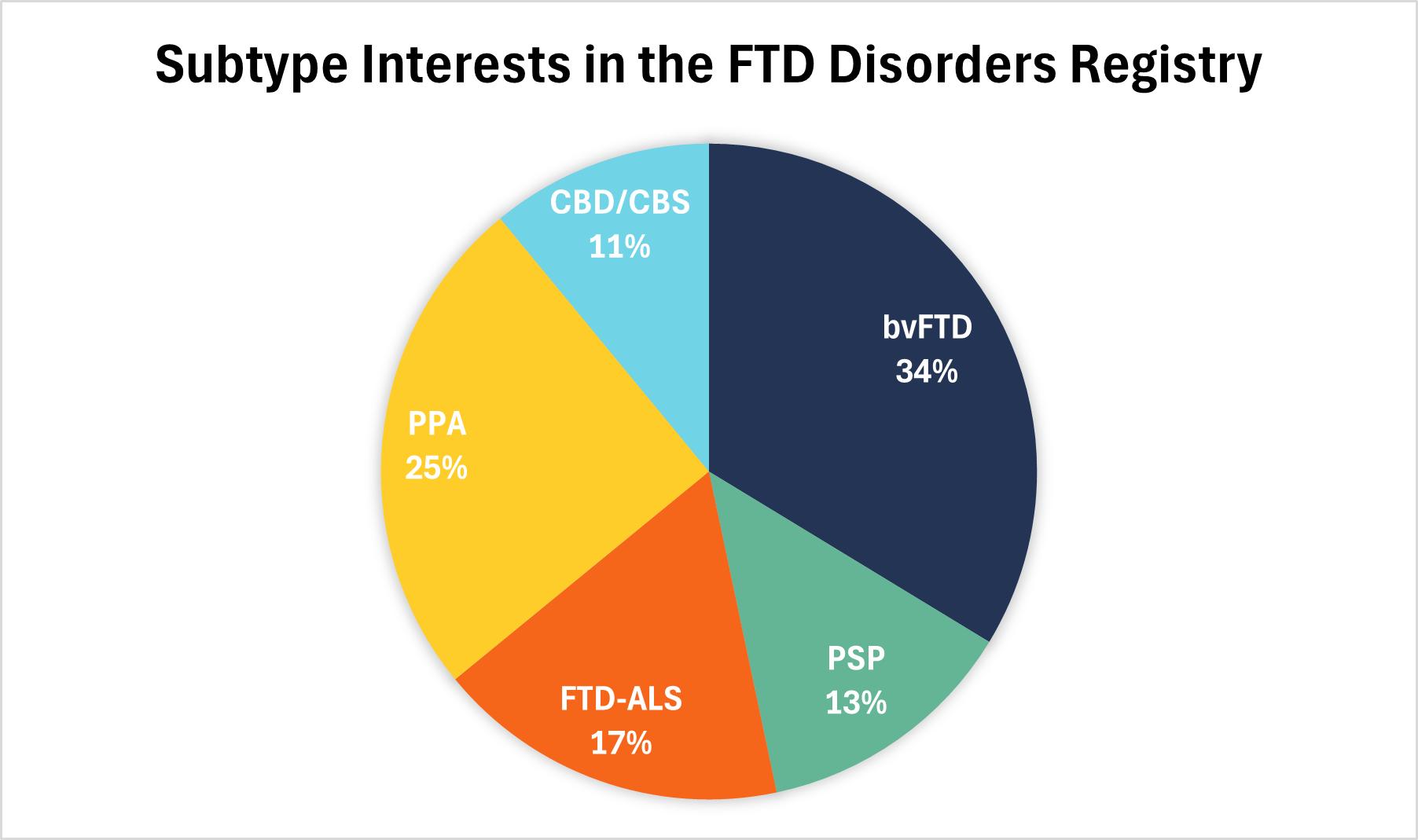
Data from September 2025
More than 34% of participants in the Registry list behavioral variant frontotemporal degeneration (bvFTD) as a focus. This makes bvFTD the subtype with the highest representation of individuals who are already informed and ready to contribute to research.
The next largest groups include participants connected to primary progressive aphasia (PPA) (25%) and FTD with ALS (17%). These groups reflect a strong presence of families and individuals engaged with both language-related and motor-related forms of FTD.
Participation related to progressive supranuclear palsy (PSP) (13%) and corticobasal degeneration or syndrome (CBD/CBS) (11%) also demonstrates a meaningful base of potential research participants in the movement-related FTD spectrum.
Genes with the Strongest Participant Pools

Data from September 2025
Among genes linked to FTD, C9orf72, GRN, and MAPT stand out as the areas with the highest concentration of research-ready participants. About 17% of Registry members identify C9orf72 as a gene of interest, followed by GRN (13%) and MAPT (12%).
Together, these three genes represent the majority of inherited FTD cases and point to communities that are already highly aware of genetic testing, family history, and opportunities to participate in research.
Interest in genes such as VCP (8%), TARDBP (8%), CHMP2B (8%), SQSTM1 (7%), UBQLN1 (8%), and TBK1 (8%) reflects a growing population of participants ready to contribute to studies on less common but important molecular pathways. Smaller groups show engagement with LRRK2 (5%) and PRKN (6%), which may support future research on overlapping mechanisms between FTD and Parkinson’s disease.
Why This Matters to Researchers
This information does more than show where interest lies. It helps researchers see where the Registry already offers concentrated groups of individuals who are ready and willing to participate in research.
High representation in bvFTD, PPA, and key genetic subtypes such as C9orf72, GRN, and MAPT points to well-established participant pools for studies on these conditions. Researchers designing clinical trials, natural history studies, or biomarker validation projects can use these insights to refine recruitment strategies and align study design with existing participant strengths.
At the same time, identifying smaller or emerging groups helps signal where more outreach or awareness may be needed to build future readiness.
This is the power of participation in action. Numbers have power. Each new member of the Registry adds clarity to the research landscape, helping investigators find the right participants and design the right studies faster.
What This Tells Us
The Registry data reveal not only where awareness is strongest but where momentum for research is already building. By identifying clusters of engaged participants across both clinical and genetic subtypes, the Registry helps bridge the gap between families seeking answers and scientists seeking discovery.
Every percentage point represents people who are ready to take part, families who have learned through experience, and researchers who can now target studies more effectively. Together, these numbers move science forward, one participant at a time.
Together we can find a cure for ftd
The FTD Disorders Registry is a powerful tool in the movement to create therapies and find a cure. Together we can help change the course of the disease and put an end to FTD.

Your privacy is important! We promise to protect it. We will not share your contact information.