


PRESS & NEWS
Who Has a Role in the FTD Disorders Registry?
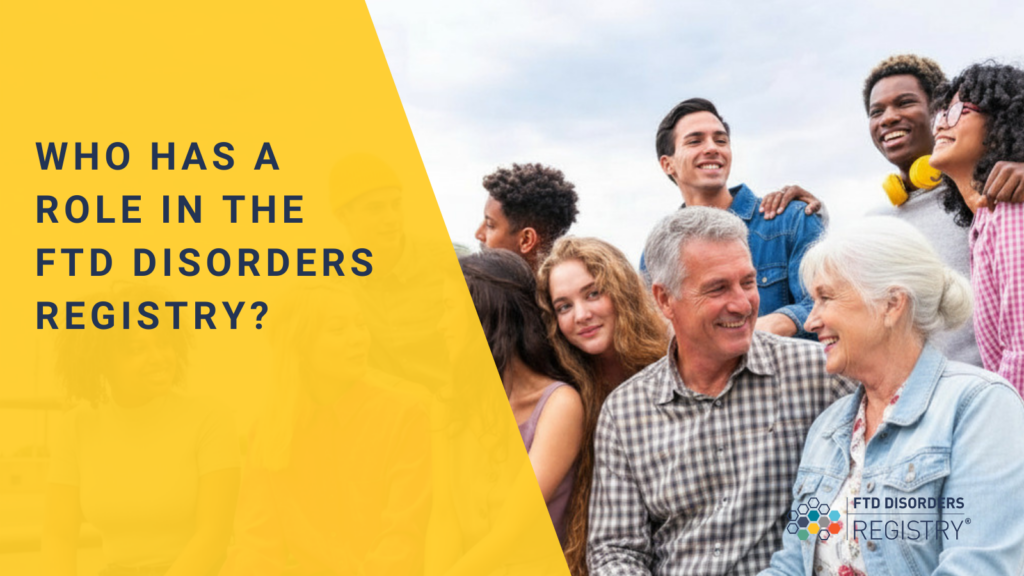
The FTD Disorders Registry was created to share the many perspectives of the lived experience of FTD disorders.
When people hear the word “Registry,” they may assume it is only for people who have been diagnosed with frontotemporal degeneration (FTD). But understanding FTD and moving research forward requires a much larger community.
People diagnosed with an FTD disorder are essential to research, but so are biological family members, care partners, and people who help a loved one participate when they can no longer do so independently.
The FTD Disorders Registry was created to bring those perspectives together and help build a stronger foundation for FTD research.
People Diagnosed With FTD
People living with an FTD disorder bring something to research that no one else can: their own experience.
Through the Registry, participants may be able to share information about their diagnosis, symptoms, health, family history, and other experiences over time. This can help researchers better understand the similarities and differences among people living with FTD disorders.
Because FTD is rare, every person who chooses to participate can add valuable information to the bigger picture.
Biological Family Members
You do not need to have an FTD diagnosis to have a role in FTD research.
Biological family members can provide information that helps researchers better understand FTD within families. Their participation may be particularly important when researchers are studying genetic forms of FTD or trying to understand why some family members develop symptoms while others do not.
Parents, siblings, adult children, and other biological relatives can all be important members of the FTD research community.
Current and Former Care Partners
Care partners experience FTD from a different perspective.
They may observe changes in communication, behavior, movement, daily functioning, and other areas that can be difficult to capture during an occasional medical appointment. They also understand how FTD impacts families and everyday life.
Current and former care partners can contribute their own experiences to the Registry, helping researchers develop a more complete understanding of FTD and its impacts.
Legally Authorized Representatives
FTD can sometimes make it difficult or impossible for a person to manage research participation independently.
That does not necessarily mean their opportunity to contribute to research has ended.
A Legally Authorized Representative, or LAR, may be able to help an eligible person with FTD participate in the Registry Research Study when that individual is unable to provide consent independently.
Including people at different stages of FTD is important. LAR participation can help researchers learn from people whose experiences might otherwise be missing from research.
People Who Want to Support FTD Research
The Registry community is broader than the Registry Research Study.
Anyone interested in FTD research can join the FTD Disorders Registry community to receive information and stay connected with FTD research.
Eligibility for specific research activities or opportunities may vary, but joining the Registry can be a first step toward learning how you or your family may be able to contribute.
Researchers and Clinicians Have a Role, Too
Families cannot build the future of FTD research alone.
Researchers need participants and data to answer important questions. Clinicians are often among the first people families turn to when they want to know what they can do to support research.
The Registry works to help connect these parts of the FTD community.
Researchers can use Registry resources to better understand potential study populations, request access to de-identified data, and explore support for research recruitment. Clinicians can help by making families aware that the Registry exists and giving them an opportunity to decide whether participation is right for them. Clinicians are also welcome to join the Registry to stay informed on new research opportunities.
Different Roles. One Research Community.
There is no single way to contribute to FTD research.
A person diagnosed with FTD may share their experience. A biological family member may contribute information about their family. A care partner may describe changes they see over time. An LAR may help someone continue to participate when they cannot do so alone. A clinician may introduce a family to the Registry. A researcher may use Registry resources to answer a new question about FTD.
Each role adds something different.
And when those perspectives come together, they can help researchers build a fuller picture of FTD and create a stronger foundation for future research.
Find your role in FTD research at www.ftdregistry.org.
Together we can find a cure for ftd
The FTD Disorders Registry is a powerful tool in the movement to create therapies and find a cure. Together we can help change the course of the disease and put an end to FTD.

Your privacy is important! We promise to protect it. We will not share your contact information.